
The ATM Skimming Incident: A Fast Fall from Criminal Heights
You may think a darknet purchase paid in Monero leaves little to investigate. Mark T.’s case shows the opposite: within 72 hours, automated fraud controls had exposed the pattern that eventually brought him five years in federal prison.
Published: — By: Derek Mason
This is not a guide to obtaining cloned cards. You are following how a 34-year-old Tampa Bay resident turned a $480 purchase into $4,900 in withdrawals, a $22,000 financial penalty, and a federal conviction.
The skeptical question is whether sophisticated tracking defeated him. In practice, ordinary records did most of the work: bank alerts, ATM logs, 23 seconds of video, exchange KYC data, and evidence kept in his apartment.
- Step 1 — Reconstruct What Mark Bought
Q: What started the case?
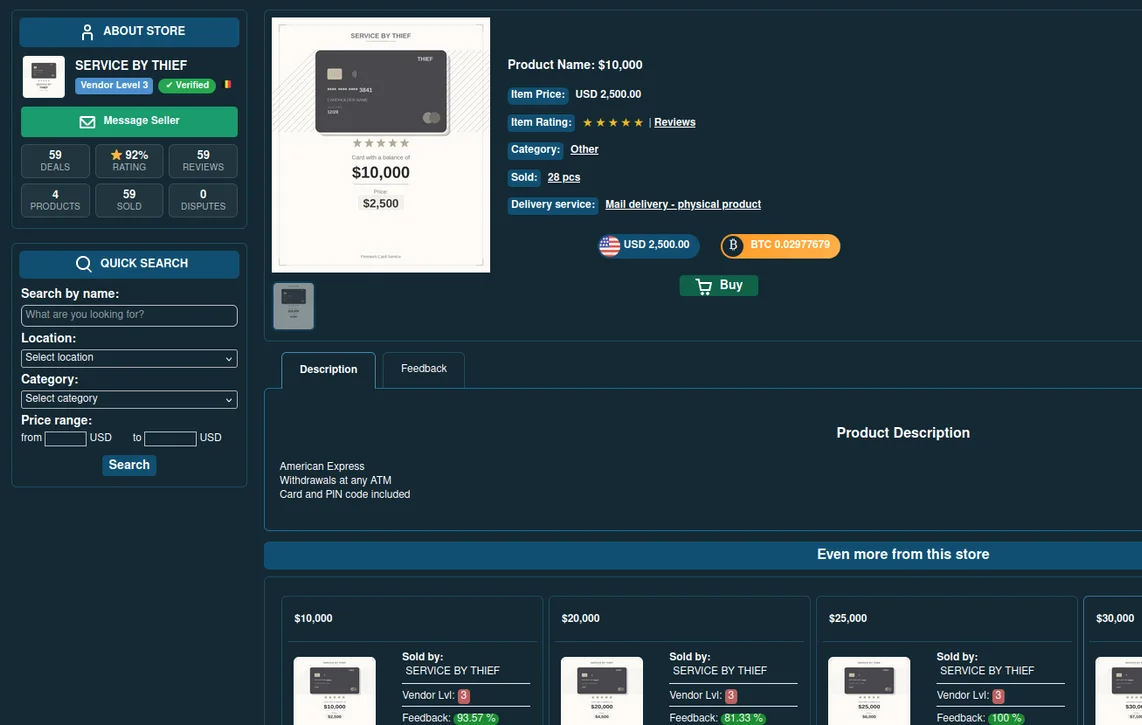
In November 2024, Mark T. bought six cloned debit cards with PIN codes from an unnamed darknet marketplace. You should note the price and payment method: he transferred $480 in cryptocurrency, specifically Monero.
The cards carried stolen magnetic-stripe data from genuine bank accounts. They arrived by mail in plain packaging and appeared usable, so Mark believed he had found easy money.
He withdrew a combined $4,200 from the first three ATMs. At a fourth machine in a Tampa Bay suburb, he collected another $700, bringing the total to $4,900.
Q: Why did the fourth withdrawal matter?
Often people assume the final transaction failed — in fact, it succeeded financially and failed operationally. The ATM gave Mark the cash, but its camera captured his unobstructed profile for 23 seconds.
You can view that machine as a cash dispenser on the front and a record keeper behind the counter. Mark wore no mask, glasses, or hat, leaving investigators with a clear face to compare against government records.
- Step 2 — Trace the Carding Chain
Q: How did the underlying scheme operate?
You can reconstruct it as a five-stage chain rather than treating the cloned card as an isolated product. Carding, meaning the sale and use of stolen banking information, is among the oldest and most persistent forms of cybercrime.
- Collect the data. Criminals obtain magnetic tracks, including track 1 and track 2, from ATM skimmers, shimmer devices, phishing, data breaches, or dumps purchased through darknet markets.
- Prepare the plastic. The stolen information is written to blank cards, which may be finished with a name, expiration date, and card number so they resemble genuine payment cards.
- Pair the PIN. When an overlay keypad or concealed ATM camera has captured the PIN, a buyer receives a card that can be used for cash withdrawals.
- Withdraw the money. The buyer visits an ATM before the account holder detects the theft and asks the bank to block the card.
- Move the proceeds. The cash may be converted to cryptocurrency through a Bitcoin ATM or a peer-to-peer exchange in an attempt to obscure its origin.
Often people think the marketplace is the riskiest point — on the facts here, the physical ATM created the decisive exposure. Labels seen in searches such as carding forums dark web, cloned cards reddit, cf card cloning, or card skimming reddit do not change that boundary between an online purchase and an observable cash withdrawal.
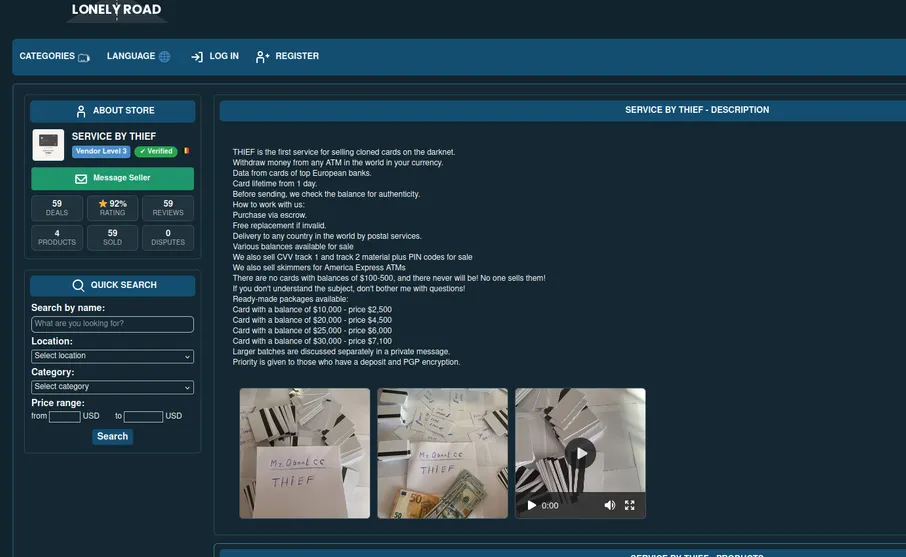
A marketplace-style interface presenting cloned-card services. - Step 3 — Examine What the ATM Recorded
Q: Was the visible camera the only source of evidence?
No—the ATM is more accurately evaluated as an integrated system of synchronized records rather than simply as a camera mounted on a vault. The table outlines the information retained by each element.
Terminal element Retained information Integrated imaging unit The customer’s face, typically captured at 1080p resolution and frequently supported by infrared illumination for recording after dark Concealed secondary camera An additional angle available on many models, with the camera hidden from external view Transaction audit record A timestamp precise to the second, the withdrawal amount, card number, ATM identifier, and transaction outcome Machine location record The terminal’s coordinates, transmitted to the bank’s records Network communications record Requests transmitted to the bank processor, including connection metadata The fourth machine recorded Mark in full profile as he withdrew $700, recovered the card, and walked away. You need only connect that 23-second clip to the exact transaction time to see why the footage mattered.
Q: What should a legitimate cardholder check?
If you are researching how to tell if a card reader has a skimmer, how to tell if there is a card skimmer, or how to check for credit card skimmers, keep the distinction clear: the source describes skimming as one possible origin of stolen tracks, but it does not identify the device that compromised these three victims.
Searches for atm skimmer images, a credit card skimming device detector, credit card skimmer protection, or a credit card skimmer protector may suggest that one gadget solves the problem. On this record, broader credit card skimming protection, card skimming protection, and any card skimming protector still depend on rapid customer reporting and bank controls, because stolen data may come from skimmers, shimmers, phishing, breaches, or purchased dumps.
- Step 4 — Follow the Investigation Day by Day
Q: How did investigators move from complaints to an arrest?
You can follow the chronology without assuming that agents immediately knew Mark’s identity.
- Day 1, November 2024. Three victims located in Florida, Georgia, and North Carolina noticed withdrawals they had not authorized. They complained to their banks, which blocked the cards and submitted the information to the early fraud warning system.
- Day 3. Automated anti-fraud algorithms detected withdrawals involving the same group of cloned cards across different states within a short period. The system raised an emergency flag, and the bank’s investigation unit received the case. This is the 72-hour point at which Mark’s activity stopped being elusive.
- Day 5. The bank referred the matter to the U.S. Secret Service, which handles financial-crime investigations. A USSS analyst requested logs and recordings from every ATM involved.
- Day 8. Footage from the fourth ATM supplied a clear facial image. A comparison against the Florida Department of Public Safety driver’s-license database matched Mark T., who had no prior convictions. Transaction analysis separately established that every withdrawal occurred within 40 miles of his home.
- Day 12. An investigator secured authority to examine browser history, ISP information, and crypto-wallet activity. ISP records showed visits to Tor exit nodes during hours corresponding to the purchase. Through a court order directed at the exchange where Mark acquired Monero, investigators connected his wallet to an account on the darknet marketplace.
- Day 14. A court authorized a residential search. In Mark’s apartment, agents seized six blank plastic cards, a magnetic-stripe read/write device known as an MSR, a laptop showing darknet-market history and traces of Tor Browser, $3,200 in cash, and packaging from the mailed order.
- Day 15. Agents arrested Mark. During questioning, he admitted buying the cards and cashing out four of the six. He had tried the remaining two, but the banks had already blocked them, so they did not work.
Often people credit a single brilliant deduction — you can instead see several modest records lining up like receipts from the same shopping trip.
- Step 5 — Check the Case Numbers
Q: What did Mark gain, and what did the case cost him?
A direct comparison of the figures gives a clearer picture than portraying the operation as easy money.
- Penalties & repayment: USD 22,000
- Cash obtained: USD 4,900
- Card expense: USD 480
- Arrest interval: 15 days
- Federal custody term: 5 years, or 60 months
- Cash-out count: 4
- Post-release oversight: 3 years
The first three withdrawals produced $4,200, while the fourth added $700. Agents later recovered $3,200 from the apartment, and its denominations matched those distributed by the ATM.
That cash detail did not create the case by itself. You should treat it as supporting evidence that strengthened a charge already backed by footage, transaction records, seized cards, and Mark’s confession.
- Step 6 — Test the Claim That Monero Protected Him
Q: Could investigators trace Monero directly?
The source does not claim that they followed every later Monero transfer. You should focus instead on the weak point before the privacy-focused currency entered the marketplace.
Mark acquired Monero from a centralized exchange where he had completed know-your-customer verification. He uploaded both a passport and a selfie, and the exchange later produced his identity and transaction history under a court order.
Although subsequent Monero movements were difficult to follow, the purchase of the correct amount on the relevant date became evidence. Often people think privacy at the middle of a route erases both endpoints — on the facts here, the regulated purchase point still carried Mark’s name.
Q: What other links supported the crypto evidence?
You should place four categories together.
- Timing: The Monero acquisition, darknet-market transaction, card delivery, and ATM withdrawals all occurred within two weeks. The overlapping windows supplied circumstantial but substantial support.
- Physical cards: Magnetic tracks on the seized cards matched dumps taken from the genuine victims, producing direct physical evidence that cryptocurrency could not remove.
- Video: The ATM placed Mark’s face at the crime scene. Even if every other part had been handled flawlessly, the footage would still have connected him to the withdrawal.
- Exchange records: KYC information joined his real identity to the purchase used for the marketplace payment.
The conclusion is narrower than saying every anonymous cryptocurrency is transparent. You can instead conclude that privacy technology did not protect Mark from KYC records, physical evidence, timing, and video.
- Step 7 — Identify the Six Operational Mistakes
Q: Which decisions accelerated Mark’s identification?
You should separate the six failures because each contributed a different form of evidence.
- He stayed near home. All four ATMs were inside a 40-mile radius of his address, creating a geographic pattern that fraud controls could flag.
- He left his face visible. With no mask, glasses, or hat, the fourth ATM produced an image suitable for comparison with the DPS driver’s-license database.
- He used a centralized exchange. The exchange’s KYC file connected his passport and selfie to the Monero acquisition later associated with the marketplace payment.
- He retained evidence in his residence. Investigators found cards, the MSR device, shipping material, and a laptop containing marketplace history and Tor Browser traces. You should not assume deletion removes every artifact, because operating-system update history can indicate software use as well.
- He kept the cash. The $3,200 found at home matched the denominations issued by the ATM, reinforcing the broader evidence.
- He compressed the activity into two weeks. The rapid series helped automated systems recognize the pattern. Spreading withdrawals across months might have delayed that alert, but the source concludes that ATM cameras would have identified him anyway.
Often people frame the failure as one bad fourth ATM visit — in reality, you can see identification, location, finance, timing, and possession evidence converging.
- Step 8 — Apply the Findings to Defensive Work
Q: What should security professionals take from the case?
You should not treat Mark as a criminal mastermind defeated by an exotic tool. The case shows routine security layers operating together, often before an investigator personally reviewed the evidence.
- Keep strengthening bank-side fraud controls. Pattern analysis, geolocation rules, and scoring models generated the first alert automatically. Banks should continue investing in machine-learning models that detect anomalies.
- Join physical and digital forensics. The ATM video was the central physical record, but the transaction log told analysts the precise second to review. Without that timestamp, the footage would have had far less value.
- Question absolute anonymity claims. A KYC exchange marked the entry into cryptocurrency, while cash withdrawal marked the physical exit. You can see how those endpoints connect online activity to a person even when the currency between them is difficult to trace.
- Improve customer education. The three victims did not detect the withdrawals immediately. Faster reporting lets a bank block a compromised card sooner and reduces what a fraudster can remove.
A common assumption is that one security layer must solve the whole case. You instead have a relay: customers reported losses, algorithms recognized the pattern, bank investigators preserved records, and the Secret Service combined those records with physical evidence.
- Step 9 — Verify the Plea and Sentence
Q: What was the final legal outcome?
In March 2025, Mark pleaded guilty to fraud and related activity involving access devices under 18 U.S.C. § 1029, along with money laundering under 18 U.S.C. § 1957. You can verify the punishment against the figures above: 60 months in federal prison, three years of supervised release, and $22,000 in fine and restitution to the three victims.
The U.S. District Court for the Middle District of Florida imposed the sentence. The judge recognized that Mark was not the organizer; he was the purchaser and final participant in the chain.
That distinction did not spare him. You should note the court’s practical conclusion: the last participant accepts the physical exposure and receives the physical punishment, while organizers farther up the network more often remain concealed.
Law enforcement addresses those higher-level actors more slowly, and the source treats that as a separate unresolved problem. Mark’s prosecution therefore closed one end of the chain, not the entire carding market.
Conclude Where Anonymity Ended
You may see privacy coins and darknet markets presented as barriers between an offense and a real identity. Mark’s case reached the opposite result because the bank alert, ATM camera, 40-mile pattern, KYC exchange account, seized magnetic tracks, laptop traces, cash, packaging, and confession supported one another.
The website where the purchase was made did not prevent the physical withdrawal from becoming evidence. If you reduce the case to one lesson, it is that online concealment ended when Mark stood unmasked before the fourth ATM.
Read next
 Navigating the Hidden Wiki on Reddit: Tips and Tricks — Explore the Hidden Wiki on Reddit with practical tips and tricks to safely navigate dark web resources and enhance your research.
 Finding Hidden Wiki Links on Reddit: A Step-by-Step Guide — Discover how to find hidden wiki links on Reddit safely and efficiently, ensuring your browsing remains secure and your data protected.